

Choosing the right high rise window cleaning equipment is about more than just getting glass clean. It's about piecing together a complete system that keeps your crew safe, makes every job run like clockwork, and nails all the strict industry regulations. For a bonded and insured business like Sparkle Tech, your gear is the bedrock of your reputation.
Choosing Your High Rise Window Cleaning Equipment
Think of your equipment less like a random collection of tools and more like a climber's carefully assembled rack. Every single piece, from a heavy-duty suspended platform to the smallest carabiner on a rope access kit, has a specific job to do. Let’s break down the whole setup so you can build a safe, compliant, and seriously effective operation, ready for any skyscraper you face.
This isn't just about good practice; it's about keeping up with a market that's exploding. The demand for professional window cleaning is through the roof, driven by all the new glass-faced towers popping up in cities everywhere.
The Booming Market for Professional Gear
Globally, the window cleaning services market was valued at a massive US$160.3 billion in 2025. It's projected to hit an incredible US$325.8 billion by 2034, growing at a steady 8.2% compound annual growth rate (CAGR).
Here in North America, the sheer number of mid- and high-rise buildings—offices, hospitals, airports—is fueling that demand. For these clients, clean windows are a non-negotiable part of their brand image. You can dig deeper into these numbers with these window cleaning industry statistics.
This massive growth means that settling for second-rate gear is not an option. Your company's reputation and, more importantly, your safety record, depend entirely on the quality of your tools. Smart choices here build client trust and keep incidents from ever happening.
A System of Integrated Components
High-rise window cleaning gear isn't just a bunch of individual items; it's a fully integrated system. The main pieces have to work together seamlessly to provide access, guarantee safety, and deliver that perfect, streak-free finish.
Your equipment is your lifeline. A complete system includes access machinery like suspended platforms, personal mobility gear like rope access kits, and the critical personal protective equipment (PPE) that ties it all together.
Here’s a look at the core components you need to get familiar with:
- Access Equipment: This is your heavy machinery. Think suspended platforms (scaffolds) and permanent Building Maintenance Units (BMUs). They give you a stable base to work from, perfect for cleaning large, flat glass surfaces efficiently.
- Mobility Gear: When you're dealing with complex architecture and hard-to-reach spots, this is what you'll turn to. Rope access systems and bosun’s chairs give technicians the agility to navigate almost any facade safely.
- Safety and Rigging: This is the gear that saves lives. It’s all the stuff that connects your crew to the building and to their access system, including full-body harnesses, lanyards, rope grabs, and the roof anchors that secure the entire setup.
Knowing which piece of equipment to use for a specific job is what separates the amateurs from the pros. This guide will walk you through each element, so you can feel confident you’re picking the absolute best tools for any building you're hired to clean.
Understanding Suspended Platforms And BMUs
When you're staring up at the vast glass face of a skyscraper, you need more than just a bucket and a squeegee. You need the heavy-duty workhorses of the high-rise world. That's where suspended platforms and their permanently installed cousins, Building Maintenance Units (BMUs), enter the picture. Both are critical types of high rise window cleaning equipment built to give teams stable, safe access to a building's exterior.

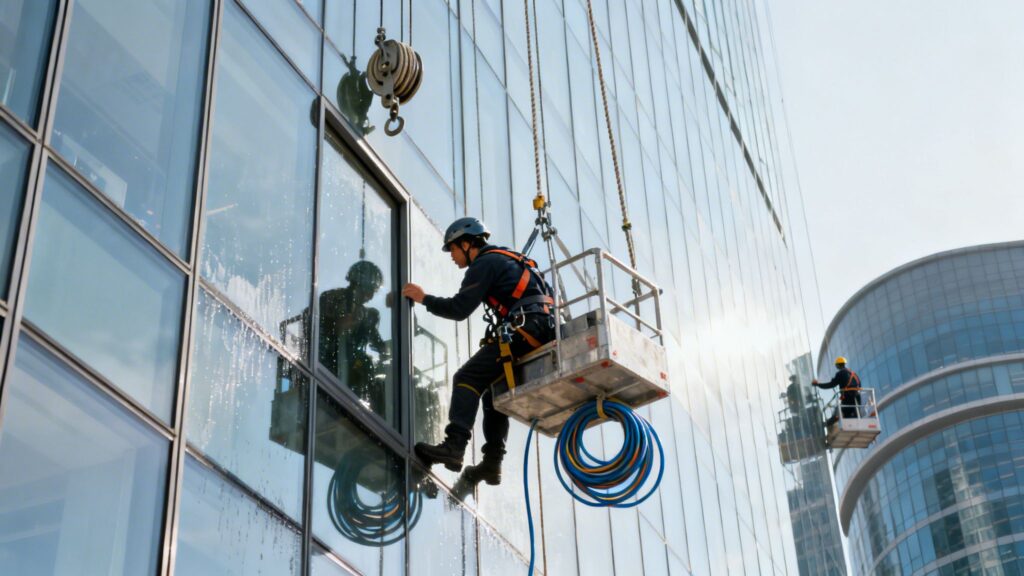
A suspended platform—often called a swing stage or scaffold—is best thought of as a temporary, high-strength elevator for the outside of a building. It's a modular system that gets assembled right on site, which makes it an incredibly flexible solution for all sorts of buildings, especially those that don't have a permanent access rig built-in.
These platforms are the go-to for big, flat surfaces. They allow a team to work methodically across a building’s facade, and since they can carry multiple technicians and all their gear, they are incredibly efficient for cleaning expansive glass curtain walls.
Deconstructing the Suspended Platform
A swing stage isn't just one piece of gear; it’s a whole system of interconnected parts that have to work together perfectly. Knowing these components inside and out is the first step toward running a safe and efficient operation.
The core of the system includes:
- The Platform (or Stage): This is the aluminum or steel deck where the crew stands. It's engineered to be light but tough enough to handle the weight of workers, tools, and supplies.
- Hoists: Think of these as the engines. These powerful motors climb the wire ropes, letting the crew position the platform exactly where it needs to be on the building's face.
- Steel Wire Ropes: Safety is paramount, so there are always two sets of ropes for each hoist. One primary set holds the load, while a second, independent safety rope is attached to a fall-arrest device. If the main system has an issue, that backup is there to catch the platform instantly.
- Rooftop Rigging: The whole platform hangs from a temporary rigging system on the roof. This usually consists of outrigger beams, heavy counterweights, and solid anchor points.
The rooftop rigging supports the entire weight of the platform, crew, and equipment. This isn't a place for guesswork. A certified 'competent person' must oversee the entire setup, making sure the counterweights and anchors exceed the operational load by a wide margin, just as OSHA mandates.
Getting the setup right isn't just a good idea—it's a life-saving protocol. A system that's improperly balanced or anchored can lead to a catastrophic failure. This is exactly why a professional company like Sparkle Tech Window Washing makes a point of being bonded and insured; it’s a direct reflection of their commitment to safe, compliant work.
The Role of Building Maintenance Units
Now, take the idea of a suspended platform, but imagine it was permanently built into the skyscraper's design from day one. That’s a Building Maintenance Unit, or BMU. These are the top-tier, custom-built crane systems you see parked discreetly on the roofs of the world’s most famous towers.
A BMU is engineered specifically for one building. It often glides along a track laid around the roof’s perimeter. From its "garage," the BMU can extend a telescopic arm over the building's edge and lower its cradle, giving maintenance crews total access to every inch of the facade.
Key Differences and When to Use Each
While they both get a platform up and down a building, the choice between them really comes down to the building's age and design.
| Feature | Suspended Platform | Building Maintenance Unit (BMU) |
|---|---|---|
| Permanence | Temporary, assembled per job | Permanent, integrated into the building |
| Best For | Older buildings, structures without permanent access, one-off projects | Modern skyscrapers, buildings with regular cleaning schedules |
| Setup Time | Requires on-site rigging and assembly for each job | Minimal setup time per use |
| Flexibility | Highly adaptable to various building types without permanent rigs | Limited to the building it was designed for |
Suspended platforms give you incredible flexibility. They’re the workhorses for cleaning and maintaining countless buildings that were put up long before BMUs were a thing. On the other hand, if you're looking at a new super-tall building, a BMU is the safest and most efficient long-term solution, having been part of the plan from the very beginning. Both are cornerstone pieces of high rise window cleaning equipment that every professional in this field needs to master.
Mastering Rope Access And Bosun's Chairs
Sometimes, a suspended platform is just too big and clunky for the job. When a building’s design gets complicated, our crews need to be more agile. This is exactly where rope access and bosun's chairs come into their own, giving technicians the mobility to tackle tricky facades and spots that would otherwise be impossible to reach. They are indispensable pieces of high rise window cleaning equipment for any modern, architecturally complex building.

The easiest way to picture rope access is to think of it as industrial-strength rock climbing, but on the side of a skyscraper. It’s a specialized technique where highly trained pros use a system of ropes, harnesses, and specific hardware to move up, down, and across a building’s face. This freedom lets them work on surfaces that a standard platform could never get to—think setbacks, swooping curves, and overhangs.
The Art And Science Of Rope Access
At its heart, rope access is all about safety through redundancy. The whole setup is built around a non-negotiable, two-rope principle.
Every technician is always connected to two completely independent ropes:
- The Working Line: This is their main support rope. They use it to control their descent or ascent with a specialized device.
- The Safety Line: This is a totally separate backup line. It’s attached to a fall-arrest device (often called a rope grab) that will instantly lock up if there's any failure in the working line or its hardware, preventing a fall.
This two-rope system is the absolute foundation of safe rope access. It's the fail-safe that ensures a technician remains secure, even in the very unlikely scenario that their primary system has a problem.
This kind of work is incredibly physical and technically demanding, which is why professional certification is mandatory. Organizations like SPRAT (Society of Professional Rope Access Technicians) and IRATA (Industrial Rope Access Trade Association) are the gold standard worldwide. A technician holding one of these certifications has proven they can handle complex rigging, perform rescues, and manage emergencies on the ropes.
For a business like Sparkle Tech Window Washing, hiring certified professionals isn’t just a good idea—it’s a fundamental commitment to the safety of our team and the security of our clients' property.
Understanding The Bosun's Chair
If rope access is the all-terrain vehicle of high-rise work, the bosun's chair is its simpler, more direct cousin. A bosun’s chair is basically a heavy-duty swing seat, designed for a single person to make a controlled vertical drop. It’s a rigid or semi-rigid seat board suspended from ropes.
A bosun's chair is primarily for moving straight up and down, unlike rope access which offers full horizontal movement. It’s often used with a small davit arm or a temporary rooftop anchor point. This makes it perfect for quick, targeted jobs, like cleaning a single vertical strip of windows or getting to an isolated spot on an otherwise straightforward facade.
Comparing Rope Access and The Bosun's Chair
So, how do you choose? It really boils down to the specific demands of the job. Each method has a distinct role in the world of high rise window cleaning equipment.
| Aspect | Rope Access System | Bosun's Chair |
|---|---|---|
| Mobility | High (vertical and horizontal movement) | Low (primarily vertical movement) |
| Best For | Complex facades, large areas, and hard-to-reach spots | Simple vertical drops, targeted repairs, and small areas |
| Crew Size | Typically two-person teams for safety and rescue | Often a single worker with a ground spotter |
| Training | Extensive, multi-level certification (SPRAT/IRATA) | Requires competent person training, but less intensive |
| Setup | More complex rigging but highly versatile | Faster and simpler setup for straightforward tasks |
Rope access gives you incredible freedom of movement, making it the go-to for buildings with challenging architecture. The bosun's chair, on the other hand, is all about efficiency for simple, straight-down jobs where you don't need complex rigging. Both highlight a core truth in our industry: the more specialized the gear, the more critical the training is to use it safely and well.
Your Essential Rigging And Safety Gear
While the big machinery like suspended platforms tends to steal the show, the true unsung heroes of any high-rise job are the personal rigging and safety components. This is the high rise window cleaning equipment that literally tethers a technician to the building and their access system. Simply put, if the access gear gets you to the work, the safety gear is what makes sure you get home.

Think of a technician's full-body harness as the roll cage in a race car. It’s not just some strap-on accessory; it's a meticulously engineered piece of equipment designed to spread the intense forces of a fall across the strongest parts of the body, preventing catastrophic injury. High-rise work simply couldn't exist without it.
The Technician's Personal Safety System
The harness is just the beginning. To be effective, it has to work seamlessly with several other critical pieces of hardware to form a complete, redundant system that protects the cleaner every second they're at height. Each component has a vital role, and they all have to function perfectly together.
This personal system is built around a few key pieces of hardware:
- Energy-Absorbing Lanyards: These are the link between the harness and a solid anchor point. They have a built-in shock absorber that tears open during a fall, dramatically softening the jolt on the worker's body.
- Rope Grabs: Essential for rope access work or when using a vertical lifeline, these clever mechanical devices slide freely along a rope. But the moment they sense a sudden downward pull, they bite down and lock instantly, stopping a fall in its tracks.
- Descenders: These devices are what allow a technician to rappel down a rope in a controlled, smooth manner. Professional-grade descenders include an "anti-panic" function that automatically brakes if the operator grabs the handle too hard or, even worse, lets go completely.
Before any work begins, it's crucial to perform a detailed, hands-on inspection of every piece of personal protective equipment (PPE). This table outlines the daily checks every technician must complete.
Essential High Rise Safety Gear Checklist
| Equipment Component | Inspection Point | Pass/Fail Criteria |
|---|---|---|
| Full-Body Harness | Check all webbing for frays, cuts, burns, or UV degradation. | Any visible damage means the harness must be retired immediately. |
| Metal Hardware | Inspect D-rings, buckles, and adjusters for cracks, sharp edges, or deformation. | Hardware must be smooth, unpitted, and operate flawlessly. |
| Energy-Absorbing Lanyard | Examine the shock-pack cover for tears; check the "tell-tale" to see if it has been deployed. | If the shock pack is damaged or has been activated, the lanyard is unsafe. |
| Rope Grab | Test the cam mechanism to ensure it engages smoothly and locks firmly on the rope. | The cam must move freely and show no signs of corrosion or wear. |
| Descender | Check for excessive wear in the rope path and test the anti-panic function (if applicable). | Any deep grooves or a malfunctioning safety feature is an automatic fail. |
A technician's life hangs on this gear, which is why this pre-use check is more than a recommendation—it's a non-negotiable rule of the job.
The entire philosophy of personal fall arrest systems (PFAS) comes down to two things: redundancy and inspection. Every piece of gear is a link in a chain, and that chain is only as strong as its most worn-out, uninspected part.
The Building's Connection Points
Of course, a technician's top-of-the-line safety gear is completely useless if it’s not connected to something solid. This is where the building's own rigging points come into play. These are the foundational anchors that connect the worker, their ropes, and their equipment directly to the structure.
The two most common types you'll see are engineered anchor points:
- Roof Anchors: These are permanent, load-rated attachment points installed right into the building’s structural steel or concrete. They are placed strategically around the roof so teams have secure tie-offs for their lifelines and suspension ropes.
- Davit Systems: Think of these as small, rotating cranes that are permanently fixed to the roof. A team can swing the davit arm out over the building's edge to lower and raise equipment, like a bosun’s chair or a small one-person platform.
With modern buildings pushing boundaries—a record 136 new structures over 200 meters were completed globally in 2024—the need for foolproof safety systems is more critical than ever. The stakes are incredibly high; 65% of window cleaning fatalities are from falls, and an alarming 85% of high-rise accidents trace back to issues with a harness or lanyard. This reality is driving the industry toward more advanced high rise window cleaning equipment, a trend detailed in the latest reports on the growth of building window cleaning systems.
Why Certification Is Not Optional
Here's the bottom line: you can't just screw an eyebolt into a roof and call it a day. OSHA regulations are crystal clear on this. Every single permanent anchor and davit system used to suspend a person must be designed by a licensed professional engineer, installed by certified professionals, and pass rigorous load testing before it's ever used.
It doesn't stop there. After installation, these systems require annual re-certification by a qualified third-party inspector. This inspection confirms that weather, building movement, or general wear hasn't compromised the anchors and that they can still hold the immense forces they were designed for. For a professional, insured company like Sparkle Tech Window Washing, using and verifying certified anchors isn't just a rule—it's central to the promise of safety we make to our clients and our crews.
The Future of High Rise Cleaning Technology
The skyline is always changing, and the tools we use to keep it sparkling have to change with it. In our world, the future isn't just about reaching higher; it's about working smarter and safer. This boils down to two major shifts: perfecting our ground game for low-to-mid-rise work and embracing automation for the truly massive skyscrapers.
Ever wonder how crews can clean the first six stories of a building without a single ladder or harness in sight? The answer is the Water-Fed Pole (WFP). Think of it as a high-tech, telescoping arm that lets a technician work from the safety of the sidewalk, completely changing the game for a huge chunk of commercial jobs.
The Science Behind Water-Fed Poles
The real secret isn't the pole itself, but the water flowing through it. A WFP connects to a purification system that strips ordinary tap water of every last mineral and impurity. This isn't just clean water; it's deionized water, and it's hungry.
Because it has no mineral content, this ultra-pure water actively pulls dirt and grime off the glass. It’s so effective that you don't even need soap. When it dries, there's nothing left to leave a spot or streak—just a perfect finish. For a business like Sparkle Tech Window Washing, offering a chemical-free, eco-friendly cleaning method is a massive selling point for clients.
The Rise of The Robots
While water-fed poles have mastered the lower levels, the next frontier is automation. Façade-crawling robots and specialized cleaning drones aren't science fiction anymore. They are becoming essential tools for safely and efficiently maintaining the world’s most intimidating buildings.
Putting a robot on the side of a skyscraper just makes sense.
- Safety First: Automation takes our technicians out of the most dangerous, high-exposure situations, dramatically cutting the risk of falls.
- Incredible Efficiency: A robot doesn't get tired. It can work around the clock, cleaning huge glass curtain walls much faster than a human team ever could.
- Flawless Consistency: You get the same perfect result on every square foot of glass, eliminating any chance of human error or fatigue.
The industry is catching on fast. In 2023 alone, the use of robotics in commercial sectors jumped by 25%. It's no surprise when you see the numbers: suspended robots can slash operational costs by 40-60%. This trend is happening right alongside a 40% surge in demand for green solutions since 2020, with 68% of firms now using water-fed poles. You can dig into more of this data in this building window cleaning systems market report.
Robotic window cleaners aren't here to replace human crews, but to augment them. They handle the grueling, repetitive work on vast glass surfaces, freeing up skilled technicians for complex rigging, detailed work, and final quality checks.
For any company looking to stay competitive, this two-pronged approach is key. You need WFP systems for the everyday jobs and a close eye on robotics for the landmark projects. This strategy ensures you have the right high rise window cleaning equipment to tackle anything from a six-story office park to a 60-story supertower with maximum safety and efficiency.
Navigating Costs And OSHA Compliance
Having the best high rise window cleaning equipment is a great start, but it won’t keep you in business on its own. The real challenge—and the mark of a true professional—is managing the nitty-gritty of costs and regulations. Getting this right is what separates the pros from the amateurs and keeps your crew safe day in and day out.
Think about what "bonded and insured" really means. It's not just a phrase you slap on your van. It's a promise to your clients that you're a serious operator who protects their property, your team, and your own business. It's this commitment that builds trust and helps you land the big, high-paying contracts.
Decoding OSHA Regulations
In the world of high-rise work, the Occupational Safety and Health Administration (OSHA) isn't just a government agency; they write the rulebook that keeps people alive. For window cleaners working at height, ignoring their standards is simply not an option. At the heart of it all are two critical areas: fall protection and equipment certification.
OSHA is crystal clear: if your team is working four feet or more off the ground, a fall protection system is mandatory. This could be guardrails, safety nets, or, more commonly for us, a Personal Fall Arrest System (PFAS).
The rulebook you need to know is OSHA Standard 1910.28. It states that every fall protection system has to be planned and overseen by a competent person. More importantly, it requires certified anchor points that can support a minimum of 5,000 pounds for each worker attached.
For a company like Sparkle Tech Window Washing, following these rules is about more than just avoiding hefty fines. It's about building a culture where safety is second nature. This means rigorous training, daily gear inspections, and non-negotiable annual certifications for every piece of equipment that holds a life in its hands.
Estimating Equipment Costs
One of the biggest financial crossroads you'll face is whether to rent or buy your high-rise gear. There’s no single right answer—it all comes down to your cash flow, how often a specific job comes up, and where you see your business in five years.
This flowchart gives you a quick visual to start mapping out your equipment strategy based on building height.

As you can see, the path is pretty clear. For buildings under six stories, water-fed poles are the smart choice. But once you start looking at taller, more complex structures, you need to think bigger.
To get more granular, let's compare the most common high-rise systems side-by-side.
High Rise Equipment Selection Guide
Choosing the right equipment is a balance of building needs, crew skills, and budget. This guide breaks down the most common options to help you make an informed decision for your next big project.
| Equipment Type | Ideal Building Height | Initial Cost (Est.) | Pros | Cons |
|---|---|---|---|---|
| Water-Fed Pole System | Up to 6 stories | $2,000 – $8,000 | Ground-level safety, eco-friendly, fast for low-rise work | Limited by height, ineffective in high winds |
| Rope Access Kit | Any height | $5,000 – $15,000 | Highly mobile, great for complex facades, minimal site disruption | Requires intensive and expensive certification (SPRAT/IRATA) |
| Suspended Platform | 5-50+ stories | $25,000 – $100,000+ | Stable work area, high efficiency for large flat surfaces | Lengthy setup time, requires extensive roof rigging |
| Bosun's Chair | Up to 30 stories | $1,500 – $5,000 | Quick for simple vertical drops, lightweight and portable | Limited to vertical movement, less stable than platforms |
While the initial purchase prices can be intimidating, remember that renting is a fantastic way to get your foot in the door. For instance, renting a suspended platform might run you $2,000 to $5,000 per week. This lets you bid on a major job without needing a six-figure investment upfront.
No matter if you rent or buy, keep a detailed gear log. Seriously. Document every inspection, every repair, and every certification. This isn't just paperwork; it's your proof of professionalism and your ultimate safety net, showing everyone that you run a tight, responsible, and secure operation.
Common Questions About High-Rise Gear
When you're dealing with equipment that operates hundreds of feet in the air, it's natural to have a few questions. We get them all the time. Let's clear up some of the most common ones we hear from building managers and new technicians.
How Often Must High-Rise Equipment Be Inspected?
Think of inspections in three layers, each one just as important as the last.
First, you have daily checks. Before a technician even thinks about going over the side, they need to give their own Personal Protective Equipment (PPE)—harness, lanyards, the works—a thorough look-over. Every single time. No exceptions.
Next, a designated "competent person" on your team should be doing a more detailed inspection of all equipment on a regular basis, usually monthly or quarterly. This is a deeper dive to catch wear and tear before it becomes a problem.
Finally, the big one. Critical systems like your suspended platforms, hoists, and especially the anchorage points on the roof have to be officially certified by a licensed third-party engineer. This isn't optional; it's an annual requirement to stay compliant with OSHA and ensure absolute safety.
What Is The Single Most Important Piece Of Safety Gear?
This might surprise you, but it’s not the harness or the ropes. It’s the anchorage points fixed to the building's roof.
Everything else—the platform, the motors, the fall arrest systems—depends entirely on those anchors doing their job. If an anchor fails, all the other state-of-the-art gear becomes useless in an instant.
Think of it this way: your safety system is a chain, and the roof anchor is the first link. Ensuring these anchors are professionally engineered, properly load-tested, and certified every year isn't just a box to check. It's the bedrock of a safe operation.
Can I Use Water-Fed Poles On Any Skyscraper?
Water-fed poles are fantastic tools, but they have their limits. They're really designed for heights up to about 60-70 feet, which is roughly five or six stories.
They are the perfect solution for cleaning a building's ground-floor facade, lobby glass, or any adjacent podiums. But for the main tower of a skyscraper? It's just not what they're built for. True high-rise work demands suspended access like platforms or rope descent systems to be done safely and effectively.
Ready to trust your property to a fully bonded, insured, and certified team? Contact Sparkle Tech Window Washing for a professional consultation and see how our commitment to safety and quality can make your building shine. Learn more about our certified high-rise services.