



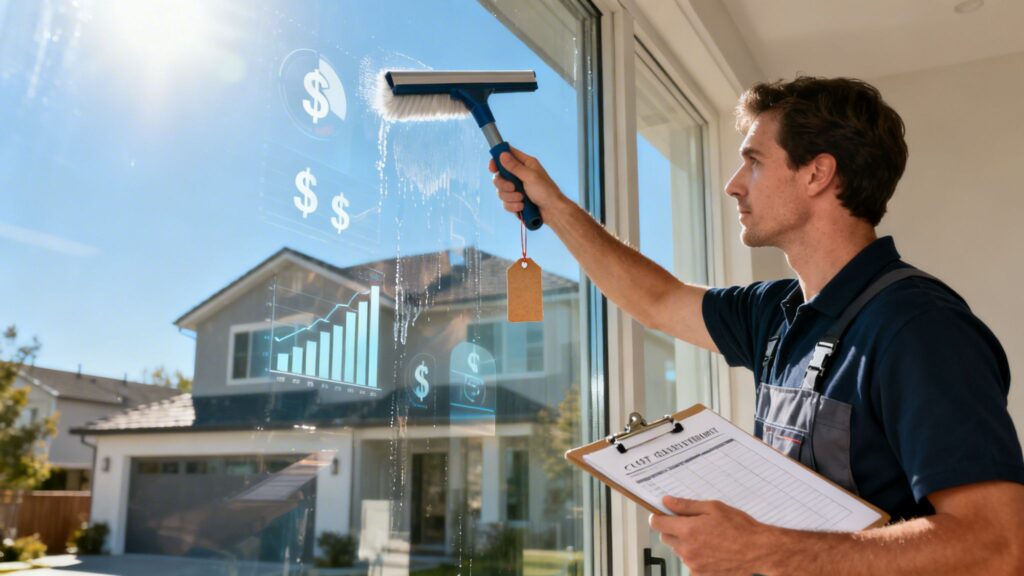
So, you're thinking about getting your windows professionally cleaned and wondering what it's going to cost. It's one of the first questions everyone asks. For most homes, you can expect the final bill to land somewhere between $150 and $350. Think of this as a solid ballpark figure to get your budget started.
Of course, that number isn't set in stone. The final price tag depends on a whole host of factors, which we'll get into soon.
What Is the Average Cost of Window Cleaning?

While the national average of $150 to $350 gives you a great starting point, your home's unique features and location will really determine the final quote. A sprawling two-story house with hard-to-reach windows will naturally cost more than a single-story ranch with simple sliders.
To truly understand what you're paying for, you need to know how window cleaning companies actually come up with their numbers. It’s not just a random price pulled from thin air; there’s a method to the madness.
H3: Common Pricing Models at a Glance
When you start calling around for quotes, you'll notice that companies price their services in a few different ways. Each approach has its own logic, and knowing the difference will help you compare apples to apples.
Here are the most common ways professionals quote a job:
- Per Pane: This is a very precise method where you're charged for each individual piece of glass. It’s perfect for homes with complex windows, like French doors or colonial grids.
- Per Window: Much simpler. Companies charge a flat rate for each standard window unit, regardless of how many panes it has.
- Per Hour: This is often reserved for unique custom homes, first-time deep cleanings with a lot of buildup, or large commercial projects. You pay for the time it takes to get the job done right.
Because companies use these different models, quotes can look wildly different at first glance. If you want to dive deeper into evaluating which pricing structure is best for your home, we cover that in our guide to the average cost of window washing.
Key Takeaway: The pricing model directly shapes your quote. A "per pane" price might be better for a modern home with large picture windows, while a "per window" price is often simpler and more predictable for homes with standard, uniform windows.
To make this even clearer, here's a quick look at how these pricing models compare.
Typical Window Cleaning Pricing Models in 2026
This table breaks down what you can generally expect to see for each pricing method. Use it as a quick reference when you start gathering your estimates.
| Pricing Model | National Average Cost Range | Best For |
|---|---|---|
| Per Pane | $3 – $7 per pane | Homes with French doors or multi-pane windows |
| Per Window | $8 – $15 per standard window | Homes with uniform, modern window styles |
| Per Hour | $50 – $100 per hour | Custom jobs or initial deep cleanings |
Remember, these are just averages. Factors like how high up your windows are, how dirty they've gotten, and even regional conditions—like the fine dust we see here in Phoenix, Arizona—all play a part. We’ll break down all those variables next so you know exactly what to look for.
How Window Cleaners Price Their Services
When you start calling around for window cleaning quotes, it can feel like you're getting a different answer from everyone. One company charges by the window, another by the hour, and a third seems to be counting every single piece of glass. It's confusing, but understanding these different pricing models is the first step to comparing quotes fairly and finding the best deal for your home.
Let's break down the four common ways professionals calculate their prices. Once you know what to look for, you'll be able to make sense of any estimate that comes your way.
Pricing Per Pane of Glass
The most detailed way to price a job is by the pane. A professional will literally count every individual piece of glass and charge a small fee for each one. So, if you have a standard double-hung window, that’s two panes.
This method is super precise, which makes it perfect for homes with unique or older windows, such as:
- French Doors: These can have a dozen or more small, individual panes.
- Colonial Windows: Those classic windows with grids that create lots of little squares.
- Transom Windows: The small accent windows you see above doors or other windows.
The upside is accuracy—you're paying for exactly what gets cleaned. The downside is that it can feel a little tedious trying to count them all yourself, and the final quote might look complex at first glance.
Charging by the Window
A much more common and straightforward approach is charging per window. With this model, the company sets a flat rate for a standard window, with different prices for larger picture windows or sliding glass doors.
This is usually the easiest method for homeowners to follow. You can do a quick walk-around, count your windows, and get a pretty solid idea of the cost yourself. It works great for most modern homes where the windows are fairly uniform in size and style.
The Hourly Rate Method
You won't see per-hour pricing as often for a typical house cleaning, but it has its place. This approach is usually reserved for jobs where the time and effort are hard to predict upfront.
Hourly rates are most common for:
- First-Time or Neglected Cleans: If it's been years and your windows are caked with dirt, hard water spots, or even construction residue, it's going to take extra elbow grease.
- Architecturally Complex Homes: Properties with tons of hard-to-reach glass, odd angles, or atriums often fall into this category.
- Large-Scale Commercial Jobs: For office buildings or storefronts, an hourly rate is often more practical than counting hundreds of windows.
The key here is communication. If a contractor suggests an hourly rate, always ask for an estimated time commitment so you have a general idea of the final bill.
The All-Inclusive Flat Rate
Finally, many of the best companies will give you a flat-rate quote for the entire job. After walking the property (or doing a virtual tour), they'll give you a single, all-in price to clean every window you've specified. This is the "no surprises" option.
This is often the most comfortable model for homeowners. You know the exact cost before the work starts, and it doesn't matter if the crew runs into a stubborn spot that takes a few extra minutes. The price is the price.
This kind of clear, upfront pricing is becoming the standard as the window cleaning industry continues to grow. In fact, the global market was valued at USD 4.18 billion in 2024 and is expected to reach USD 6.8 billion by 2033. That growth is fueled by homeowners who want reliable, professional service without hidden costs. For a closer look at how professionals determine these prices, you might be interested in our guide on how much to charge for window cleaning services.
What Factors Influence Your Window Cleaning Cost
While pricing models give you a ballpark idea, the final number on your quote comes down to the unique details of your home. A handful of key variables can swing the price up or down, turning a simple job into a more complex project. Getting a handle on these factors is the best way to understand what you'll actually pay.
You can think of it like this: a basic, ground-floor window is the starting point. But every complication—like needing a 30-foot ladder or dealing with tricky colonial panes—adds to the job's complexity and, naturally, its cost.
Window Accessibility and Height
The first thing any pro will assess is how hard it is to get to your windows. This is probably the biggest single driver of cost. A technician can move quickly and safely across a row of ground-floor windows, but the job changes completely the moment a ladder comes out.
- Ground-floor windows are always the cheapest. They're quick, safe, and don't require any special equipment.
- Second-story windows will bump up the price. This involves ladder work, which means more time and careful safety procedures.
- Third-story windows (or higher) are the most expensive to clean. These often demand specialized gear like tall extension ladders or water-fed poles to do the job right without putting anyone at risk.
This infographic shows the basic pricing structures that companies start with before adding in job-specific factors like height.

A company will use one of these models as a foundation, but accessibility is the first major adjustment they’ll make to that base rate.
Window Type and Complexity
Let's be honest—not all windows are the same. A big, modern picture window is a breeze to clean compared to a classic French door with dozens of individual panes.
Key Insight: The more time and meticulous effort a window demands, the more it will cost. Most experienced companies have set pricing tiers for different window styles.
Here’s a quick breakdown of what to expect:
- Sliding or Picture Windows: These are usually the baseline. Their large, flat glass surfaces are straightforward and fast to clean.
- Double-Hung Windows: Because these have two separate sashes that move, there are more edges and surfaces to detail.
- French Panes or Colonial Grids: These are the most time-consuming by a long shot. Every single small pane has to be cleaned and detailed individually, which can significantly increase the time and price. We cover this in much more detail in our guide to the window cleaning cost per window.
The Level of Grime
Just how dirty are your windows? There's a world of difference between a light coating of seasonal dust and a window that hasn't seen a squeegee in five years.
- Standard Dust and Dirt: A normal seasonal cleaning is what the base price typically covers.
- Heavy Grime: If it’s been a while, expect an upcharge. It simply takes more time, effort, and cleaning solution to cut through thick layers of buildup.
- Construction Debris: Things like paint overspray, sticker residue, or concrete splatter are a major headache. Removing them safely requires specialized scrapers and solvents to avoid scratching the glass, and this will always add to the bill.
- Hard Water Stains: Here in Phoenix, this is a big one. Mineral deposits from sprinklers can get baked onto the glass, leaving chalky white stains. Getting these off requires special acidic cleaners and a lot of elbow grease, which is always an add-on service.
Add-On Services and Industry Costs
Many people choose to bundle other services with their window cleaning. It’s an efficient way to knock out a few chores at once, but remember that each add-on will increase your total bill.
Some of the most common extras include:
- Screen Cleaning: Removing, thoroughly washing, and reinstalling all your window screens.
- Track and Sill Detailing: A deep clean of the channels and frames where gunk loves to build up.
- Solar Panel Cleaning: Since the crew is already equipped with ladders, adding on a solar panel cleaning is a smart and popular choice.
It's also worth noting the bigger picture. The U.S. window cleaning market is projected to hit $2.9 billion in 2024, spread across over 35,344 businesses. For these companies, labor can represent up to 50% of their total costs, not to mention insurance, fuel, and equipment.
These operational expenses, right down to the customer acquisition cost by industry, are all baked into the final price you pay. From your home's layout to the company's own business costs, every piece of the puzzle helps determine the number on your estimate.
Real-World Window Cleaning Cost Scenarios
Pricing models and cost factors are great on paper, but what do the numbers actually look like for a real home? Seeing a few example quotes is where it all starts to make sense. Let's break down some common job types to give you a feel for what you can expect to pay.
Think of these as benchmarks. By looking at a few typical homes and service requests, you can get a much clearer idea of what a realistic budget looks like for your own property.
Example Quote 1: The Standard Single-Story Home
First up, let’s look at a classic Phoenix-area home: a 1,500 sq. ft. single-story house. We'll say it has about 15 standard, double-hung windows, and a crew can easily reach all of them from the ground.
This is about as straightforward as a window cleaning job gets. No special equipment, no high-risk ladder work—just a simple, efficient clean.
- Service: Interior and exterior cleaning for all 15 windows.
- Complexity: Low. All windows are on the ground floor.
- Estimated Cost: You should expect a quote in the $175 to $225 range.
Because the job is so accessible, a professional can work quickly and safely. This efficiency is why it’s one of the most affordable scenarios.
Example Quote 2: The Larger Two-Story House
Now, let's move up to a bigger family home, maybe around 3,500 sq. ft. with two stories. This place has closer to 30 windows, including a mix of sliders, a couple of large picture windows, and several second-story windows that are out of reach from the ground.
The moment ladders come into play, the job's complexity, time, and safety requirements go up. That added effort will always be reflected in the final price.
- Service: Interior and exterior cleaning for 30 mixed-style windows.
- Complexity: Medium. This job requires ladder work for second-story access.
- Estimated Cost: For a home this size, the price would likely fall between $300 and $450.
This is the perfect example of how building height becomes a major price driver. If those same 30 windows were all on a single level, the cost would be significantly lower.
Example Quote 3: The "All-In" Package
Many homeowners, especially here in dusty Arizona, decide to get everything done at once. It’s convenient and almost always saves money. Let's go back to our 1,500 sq. ft. single-story home but add a couple of popular services.
This time, the owner wants the windows cleaned inside and out, plus a deep cleaning of all 15 window screens and their home’s 20 solar panels.
Pro Tip: Bundling services like window, screen, and solar panel cleaning is one of the smartest ways to get more for your money. Companies often give a package discount because their crew and equipment are already at your house, which saves them a trip.
- Service: Windows, screens, and solar panel cleaning.
- Complexity: Low to medium, mostly due to the extra time for the add-on services.
- Estimated Cost: This combined service package would probably be quoted from $350 to $500.
While the total ticket is higher, the price you pay for each individual service is less than if you'd booked them all separately.
Example Window Cleaning Quotes for Different Home Types
To help you budget, here’s a table that summarizes these examples. It's a great tool for comparing estimated window cleaning costs for different residential properties. Find the profile that most closely matches your own home to get a ballpark idea.
| Home Profile | Number/Type of Windows | Additional Services | Estimated Cost Range |
|---|---|---|---|
| 1,500 sq. ft. Single-Story | 15 Standard Windows | None | $175 – $225 |
| 3,500 sq. ft. Two-Story | 30 Mixed-Style Windows | None | $300 – $450 |
| 1,500 sq. ft. Single-Story | 15 Standard Windows | Screen & Solar Panel Cleaning | $350 – $500 |
As you can see, the cost of window cleaning isn't just one number. It’s a flexible price that changes based on your home’s specific features and the services you need.
DIY vs. Hiring a Professional Window Cleaner

When you see a quote for professional window cleaning, it’s only natural to think, "I could probably do that myself and save some money." The appeal of a DIY project is strong, but it's worth taking a moment to weigh those potential savings against what it really takes to get the job done right.
On the other hand, hiring a pro has its own cost, but it also buys you a level of quality, safety, and speed that's nearly impossible to match on your own. This isn't just a simple calculation of money; it's a decision about your time, your safety, and the final look of your home.
The Real Cost of DIY Window Cleaning
At first glance, going the DIY route looks like an easy financial win. You grab some basic supplies, block out a Saturday, and pocket the cash you would have paid a pro. But let's be honest—the true investment goes far beyond a bottle of Windex and a roll of paper towels.
If you want results that even come close to what a professional delivers, you're going to need the right equipment. That often means buying:
- A quality squeegee and applicator: Using a cheap, flimsy squeegee from the hardware store is a one-way ticket to a streaky, frustrating mess.
- Specialized cleaning solutions: The pros use soaps and solutions designed to cut through tough grime and mineral deposits without leaving behind a hazy film.
- A sturdy, safe ladder: For any second-story windows, this is non-negotiable. A good ladder is a significant upfront cost and a serious piece of equipment.
- Buckets and microfiber cloths: You need the right tools to apply the solution and detail the edges for a perfect finish.
Even after you've bought all the gear, you have to consider the biggest hidden cost: your time. A job that a trained crew can knock out in a couple of hours could easily eat up your entire weekend. And then there's the very real danger of working on a ladder, especially if you aren't experienced with proper placement and fall-prevention techniques.
The Value of Hiring a Professional
Hiring a pro is really an investment in quality and your own peace of mind. The most obvious benefit is a flawless, streak-free shine that lets all that beautiful natural light pour into your home. A seasoned professional knows exactly how to tackle every type of window, from old single-panes to modern coated glass, without leaving a single smudge.
Safety is another massive advantage. Trained technicians use commercial-grade equipment and follow strict safety protocols, which completely eliminates the risk of you taking a fall. This is especially critical for multi-story homes or houses with windows over sloped or uneven ground.
Professionals bring an efficiency that a weekend warrior just can't replicate. Their experience, combined with powerful tools, allows them to produce superior results in a fraction of the time.
There’s a reason the window cleaning industry keeps growing. In the U.S. alone, it has expanded by an average of 2.3% per year from 2019 to 2024. Part of this is due to modern equipment, like water-fed poles, that can reduce labor time by 30%. This efficiency is a huge part of the value you get, especially in dusty climates like Arizona where clean windows are in high demand. You can learn more about what’s driving the demand for professional window cleaning on windowgenie.com.
A Side-by-Side Comparison
To help you decide, let's break down how the two approaches stack up against each other.
| Feature | DIY Window Cleaning | Professional Window Cleaning |
|---|---|---|
| Cost | Lower upfront cost, but requires you to buy all the tools and supplies. | Higher upfront cost, but it's an all-inclusive price for labor, tools, and insurance. |
| Results | Often inconsistent. Streaks, smudges, and missed spots are common. | A guaranteed streak-free, crystal-clear finish every time. |
| Time | Can easily consume a full day or an entire weekend. | Usually done in just a few hours. |
| Safety | High risk of falls and injury, particularly when using ladders. | Extremely low risk. Professionals are trained, insured, and use proper safety gear. |
Ultimately, the right choice comes down to what you value most. If you have a small, single-story home and genuinely enjoy hands-on projects, DIY could be a good fit. For most homeowners, however—especially those with larger homes, multiple floors, or a desire for pristine results without the hassle—hiring a professional offers unbeatable value.
Alright, you've figured out the ballpark cost for getting your windows cleaned. That's half the battle. Now comes the part that's just as crucial: picking the right crew for the job.
Finding a window cleaning company you can trust is about more than just a low price. It’s about protecting your home and getting that crystal-clear finish you’re paying for. It can feel like a shot in the dark, but asking a few key questions will quickly tell you who the seasoned pros are and who you should steer clear of. Think of it as a quick vetting process to give you peace of mind.
Essential Questions to Ask Every Contractor
Before you even think about saying "yes" to a quote, you need to ask a few non-negotiable questions. Any professional company will have immediate, clear answers. If you get hesitation or vague replies, consider it a major red flag.
Let's start with the single most important question: “Are you fully insured and bonded?”
- General Liability Insurance: This is what protects your property. If a ladder slips and cracks a window or dings your siding, their insurance policy pays for it—not your homeowner's insurance.
- Workers' Compensation: This one is huge. If a technician gets injured while working at your house, this insurance covers their medical bills. Without it, you could be held liable, and that’s a financial nightmare you don’t want.
- Bonding: Think of this as theft and incompletion insurance. It’s an extra layer of protection for you if the job isn’t finished or if something goes missing.
A legitimate company will have no problem showing you proof of their insurance and bonding. Many even carry it with them. If they can't or won't provide it, walk away. The few dollars you might save aren't worth the massive financial risk.
Clarify What Is Included in the Quote
Once you've confirmed they’re properly insured, it's time to nail down exactly what their price covers. A detailed, itemized quote is your best friend—it prevents frustrating misunderstandings and surprise fees on the final bill.
Get specific with these follow-up questions:
- What does your quote include? Does the price cover the inside and outside of the glass? What about cleaning the screens, wiping down the window sills, and clearing out the tracks? These are often add-ons, so be sure to ask.
- How will you protect my home and landscaping? A pro team will lay down drop cloths to protect your floors and furniture inside. Outside, they should be careful around your delicate flower beds and shrubs.
- What is your process for hard-to-remove debris? If you have stubborn hard water stains, paint overspray from a recent project, or artillery fungus, ask how they tackle it and if it costs extra.
To get the most accurate estimate, give them as much detail as possible. Sending a few photos of your windows, especially any that are hard to reach or have specific issues, helps a company give you a firm price. Be skeptical of any company that gives you a rock-bottom price over the phone without seeing your property—it’s often a bait-and-switch tactic or a sign they don't know what they're doing.
Frequently Asked Questions About Window Cleaning
You've got the basics on pricing and how to spot a great company. But you probably still have a few questions floating around. Let's tackle some of the most common ones I hear from homeowners every day.
How Often Should I Clean My Windows?
For most homes, a professional cleaning at least twice a year is the sweet spot. This schedule is usually enough to keep grime from building up and potentially damaging your glass, all while keeping your view crystal clear.
Of course, your local environment is a huge factor. If you're near a busy street or in an area with a lot of pollen, you might want to bump that up to quarterly. Here in Phoenix, that fine desert dust and the aftermath of a monsoon storm can coat windows in a hurry, making more frequent cleanings a popular choice.
Is Interior and Exterior Cleaning Priced Differently?
Yes, they are almost always priced separately. The exterior clean usually costs a bit more. That’s because the outside of your windows takes the brunt of the weather, accumulating tough-to-remove grime like bird droppings, hard water spots, and baked-on dirt that requires more elbow grease and ladder work.
This is why many homeowners opt for a mix-and-match schedule. They might get the exterior cleaned twice a year to maintain curb appeal, but only have the interior done once.
Key Insight: When you get a quote, always double-check if it's for the exterior, interior, or both. This simple question prevents any confusion on cleaning day and ensures you're comparing apples to apples when looking at different bids.
What Should I Expect on Cleaning Day?
A professional crew should make the entire process completely seamless for you. When they arrive, they'll introduce themselves and do a quick walk-through with you to confirm the job details and point out any areas of concern.
From there, you can expect them to:
- Carefully move any furniture or decor away from the windows.
- Protect your floors, carpets, and window sills with drop cloths or towels.
- Work through your home methodically and efficiently.
- Put everything back exactly where they found it once they're done.
The goal of a true professional is to leave your home just as they found it, only with brilliantly clean windows. There should be minimal disruption to your day.
Ready to see how affordable sparkling windows can be? The team at Sparkle Tech Window Washing provides detailed, transparent quotes for homes all across Arizona. Get your free estimate today!